A personal journey through the Psalms as I navigate life. A journal born of intense emotional pain. What I am learning from my daily worship, walk, and God's Word. I dedicate this blog to Christ's glory.
We could start by discussing whether the NIV’s translation of the Hebrew word rānah as “sing joyfully” is correct. Other versions translate it as “rejoice” (which conveys the emotion but not the method) or “shout” (which conveys the method, but not the emotion). But that discussion can come later.
I want to look at that issue right now. I looked up the words in the first three verses related to praise, and made a little chart.
Verse
Strongs #
Hebrew
NIV
ESV
NLT
KJV
1a
7442
ranan
sing Joyfully
shout for joy
shout for joy
rejoice
1b
8416
tehillah
praise
praise
praise
praise
2
3034
yadah
praise
give thanks
praise
praise
3a
7891
shyir
sing
sing
sing
sing
3b
8643
teruw`ah
shout
loud shout
sing with joy
loud noise
You can see how each version translates the Hebrew word or words used in each verse. Although the English versions show eight variations, they generally focus on three actions: sing, shout, and praise—with a couple of exceptions. In verse 2, the ESV renders yadah as “give thanks,” while the NIV, NLT, and KJV use “praise.” For verse 3b, the NLT says “sing with joy,” whereas the other translations highlight a sense of loudness. All versions are consistent with one another in only two verses. In verse 1b, each employs the English term “praise,” and in verse 3a, all utilize the term “sing.” Verse 2 is similar; however, the ESV renders yadah differently.1
As you can see, there are five different Hebrew words used in these three verses, but they have been translated eight different ways between all four versions. I’d prefer not to spend too much time thoroughly exploring how these words can be translated. Upon reviewing multiple reference sources regarding each term, it becames evident that reasonable arguments exist in support of all of them. I have given the Strong’s #s where you can study further if you have that resource, as well as more extensive reference works that also use the Strong’s numbering system.2
Many of you are scratching your heads by now. Why go to all this trouble? After all, when you boil it down, they are all conveying the same message. Praise should be joyous and often coupled with gusto (i.e., “shout” or “loud”). However, Psalm 33:1-3 should not be used as a prooftext for how worship should be practised. Rather, we can glean principles to apply in our own time and setting.
Worship inWitness
If praise is “fitting” for the “upright,” then it should be done in a fitting manner. Can one praise without joy in their soul? We must distinguish a praise song from a song sung in praise. The term “praise song” has come to refer to a specific style of song. But even those “praise” songs can be sung mindlessly and without joy. It’s not about style but about sincerity.
Take a well-known hymn, “Holy, Holy, Holy.” Most Christians can probably sing this without a hymnal or on a screen. They have memorised it by heart, but may lack genuine feeling—a heart meant for praise can also be empty of joy. Even when the words come easily, the heart might remain untouched. Sometimes, a heart can echo with ritual yet never awaken to true delight. And if you ask many Christians to name a praise song, this hymn will most likely not make the list, even if you are more “traditional” in your worship service.
Humans have a natural tendency to categorize. However, classifying songs—much like reciting them mechanically—does not necessarily ensure genuine engagement in the manner intended by the composer. It’s common to ask, “What songs did you sing in church today?” with someone replying, “We sang some great praise songs.” Afterward, they may leave feeling they’ve completed everything: attended the service – check, sang praise songs – check, worshipped – check, and listened to the Word preached – check.
A better question we should ask and answer ourselves is, “Did I sing with a sincere heart of joy and thanksgiving?” If the answer is, “not really,” then we cannot say we “sang a lot of praise songs.” Because the external arrangement of notes or words is meaningless, if we have sung only for our personal pleasure and fulfillment, let us instead pursue an internal attitude of joy directed towards our glorious Lord.
There’s still much to discuss, but I will save it for my next journal entry. I hope to deepen my self-reflection regarding praise, as I also need to address the questions raised earlier.
Enlighten the eyes of my heart, remove its blindness
May this prayer not end with a focus on me
Nor on my personal petitions for self-edification and pleasure
But in You be all my glory and praise, my Lord and God, my Savior, my treasure
~ Amen
Holy, Holy, Holy by Reginald Heber (1826) tune “Nicaea,” by John Bacchus Dykes (1861)
Holy, holy, holy! Lord God Almighty! Early in the morning our song shall rise to Thee; Holy, holy, holy, merciful and mighty! God in three Persons, blessed Trinity!
Holy, holy, holy! All the saints adore Thee, Casting down their golden crowns around the glassy sea; Cherubim and seraphim falling down before Thee, Who was, and is, and evermore shall be.
Holy, holy, holy! Though the darkness hide Thee, Though the eye of sinful man Thy glory may not see; Only Thou art holy; there is none beside Thee, Perfect in pow’r, in love, and purity.
Holy, holy, holy! Lord God Almighty! All Thy works shall praise Thy Name, in earth, and sky, and sea; Holy, holy, holy; merciful and mighty! God in three Persons, blessed Trinity!
Below are two videos I discovered while looking for a video for Holy, Holy, Holy. They are two videos sung by the same people, but the first one doesn’t have the lyrics shown while singing. The second one does. The first one is great for sitting back, closing your eyes, listening to the lyrics, and perhaps using your imagination. The second is great if you want to see the actual lyrics in English and Hebrew. Just click on them and they will play. This is a long song (over 11 minutes), but it’s worth listening to!
NOTES & QUOTES :
1 The Hebrew word yadah, translated as “Give thanks” by the ESV, conveys both Praise and Thanks. Most reference works available to me prefer to translate it as “praise.” One such resource, after discussing one of the meanings of this word, says: (You can skip down to the highlighted sentence if you are not interested in the technical jargon)
Second, this verb was predominantly employed to express one’s public proclamation or declaration (confession) of God’s attributes and his works. This concept is at the heart of the meaning of praise. Praise is a confession or declaration of who God is and what he does. This term is most often translated “to thank” in English versions, but such is not really a proper rendering according to Westermann: In the Old Testament… there is as yet no verb that means only “to thank.” Yadah, which is usually translated as “to thank,” is not used in the Old Testament a single time for an expression of thanks between men. Thus, it is clear from the start that this yadah
cannot be equated with our “to thank,” which can be directed equally to God and to man. In those places in the O.T. where our “thank” as something taking place between men is most clearly found, the verb used is
barak, which does not have the primary meaning of “praise” but means “bless.”
2 I use Logos software, which is an excellent resource. Their software packages can be costly and may be more than you need. They offer online subscriptions that are much more affordable. I have the Max Pro subscription, but they also offer lower-priced options that will probably meet all your needs. https://www.logos.com/configure/subscriptions?trackId=191
Not all the reasons, of course, but reasons stated in the first 5 verses of Psalm 33. I say stated, because there are many reasons implied throughout the Psalm. Even the subpoints under the headings aren’t exhaustive or consistent. For example, the subheadings under the first heading covering verses 1-5 need to be expanded on. And as you see, I used alliteration. In contrast, the subheadings under II-IV are not alliterative. But that’s enough clarification and self-criticism.
We could start by discussing whether the NIV’s translation of the Hebrew word rānah as “sing joyfully” is correct. Other versions translate it as “rejoice” (which conveys the emotion but not the method) or “shout” (which conveys the method, but not the emotion). But that discussion can come later.
I want to focus on the Hebrew word nāʾweh, which is translated as “fitting.” If you consult various translations, you will find that you can break them down into two basic adjectives: one that describes its appearance, and the other that describes its appropriateness or suitability. Versions like the CSB (Christian Standard Bible) translate nāʾweh as “beautiful,” which corresponds to the first description (appearance). While others, such as the NIV, render it as “fitting,” which corresponds to the second description (suitability). The KJV uses the word “comely,” a word not used much, if at all, today. It also refers to the attractiveness of a person or activity, though it can, secondarily, mean ‘proper’. The Amplified version incorporates both meanings in its translation of verse one: “praise is becoming and appropriate” – AMP (Amplified). Though the word “becoming” can refer to something that is either attractive or appropriate.
A look at Hebrew dictionaries and lexicons doesn’t shed much light on the matter, since the word is used elsewhere with one or the other meaning in mind. The only other passage in the Psalms faces the same translational variances (see Psalm 147:1 NIV, NASB) . Passages outside the Psalms don’t help either. Some contexts demand that it be translated as lovely or beautiful (E.g., Song of Songs 2:14). In contrast, others require the meaning of fitting or appropriate (e.g., Prov. 17:7). However, in the case of Psalm 33:1, both meanings are possible.
Instead of getting bogged down in the arguments for why it should be translated one way or the other, I am going to say that both meanings are “fitting” for God’s people (“the upright”). That to sing or shout out our praise is both beautiful and appropriate in our worship (“decently and in order,” of course-1 Cor. 14:40). I say “our” in a corporate sense, though private praise is fitting and beautiful too. But here, the psalmist is exhorting the “righteous” (plural in Hebrew) to worship the Lord.
Sing joyfully to the Lord, you righteous –Ps 33:2 NIV (2011)
Many today who claim to be Christians say, “I don’t have to go to church; I can worship at home or out in nature.” Worshipping at home and out in God’s wonderful creation is undoubtedly good, helpful, and edifying. However, Scripture also exhorts us to meet together in shared fellowship.
Worship in Witness
I recently read an article that said Gen Z and millennials were returning to church. Yet, when you dig into the article, you discover that the average attendance has risen to 1.8 or 1.9 times per month, meaning less than half of the month. And this was contrasted with COVID-19 attendance, during which many churches were shut down. When I was attending Bible College back in the 1970’s, there was the running joke about people attending “Bedside Baptist” or “Parkway Presbyterian.” Many disregard the exhortation in Hebrews not to forsake “the assembling of ourselves together” (Heb 10:25 KJV).
The ESV translates this verse this way:
not neglecting to meet together, as is the habit of some, but encouraging one another, and all the more as you see the Day drawing near. The Holy Bible: English Standard Version (Heb 10:25). (2025). Crossway Bibles.
Verse 25 serves as the instrumental means to fulfill the exhortation found in verse 24:
And let us consider how to stir up one another to love and good works,
Verse 25 tells us how to accomplish the exhortation given in verse 24. How are we to “stir up one another to love and good works?” The comma at the end of verse 24 in the ESV points to verse 25, which tells us that we do this through our meeting together and “encouraging one another.” But note that there were some whose “habit” was to ignore or avoid joining in their local fellowship of believers, as it is today, sadly.
What is more “befitting” or “beautiful” than when the blood-bought body of Christ comes together and worships the Lord through the preaching of God’s word? Where we sit, as it were, at the feet of Jesus, having chosen the “good part,” “right thing,” or the “best part” (see Luke 10:42).
What is more appropriate or attractive when God’s family joins together in praise?
Praise the Lord! For it is good to sing praises to our God; for it is pleasant, and a song of praise is fitting. Psalm 147:1 ESV
Praising God takes our eyes off our problems and onto the Lord, in whose hands we are held (see John 10:27-30). Who works all things out for His glory and our good (see Rom 8:26-31). Who is both our Sovereign Lord (see Isaiah 46:9-10 and sympathizing Savior (see Hebrews 4:14-16 ESV, NLT).*
For we do not have a high priest who is unable to sympathize with our weaknesses, but one who in every respect has been tempted as we are, yet without sin.
Hebrews 4:14-16 ESV*
And it not only exalts God, but it is a means of grace by which God edifies us. Colossians 3:16 sums up the beauty, benefit, and befittingness of the ministry of preaching and of praise.
Let the word of Christ dwell in you richly, teaching and admonishing one another in all wisdom, singing psalms and hymns and spiritual songs, with thankfulness in your hearts to God.
Hebrews 10:24-25 shows us the goal of fellowship: to “grow in love and good works.” We do this in light of “the day” (see Mt 24:44). That is, in light of the imminent return of the Lord in “an hour” we “do not expect”, which encourages us to be found worshipping and working for the Lord when He comes. It also reminds us that there is strength in numbers. An ember separated from the fire will soon go out. Habitually avoiding Christian fellowship can lead to depression and loneliness. It also reveals what we value most.
For where your treasure is, there your heart will be also. – Matt 6:21 NIV
But meeting together with other believers can have the same results as not attending. If we are not open to giving and receiving encouragement, or if our services are not conducive to achieving this, the results will be the same. Furthermore, if we only go to revel in the pleasure of enjoying the music, song, and preaching for ourselves, we may go home “blessed.” But we will not bless anyone else. How many times have you heard someone say, “I like going to church because it just makes me feel good?” I call them (and myself sometimes?) Dead Sea Attendees. Like the Dead Sea, where the water flows in but has no outlet. And they cannot sink because of the water’s saltiness. They take it all in and float all the way home. However, they never allow it flow out to help a brother or sister who is drowning in their sorrows, sins, and struggles.
Returning to Psalm 33:1, we can now see that the participle “fitting” serves to describe the need and necessity of praise in the life of the believer, both personally and corporately in the body of Christ. I believe this one word prompts the Bible explorer to look further along the path to find out why it is “fitting” and “beautiful.” A path that leads through the rest of Psalm 33 (and throughout all of Scripture) to find the treasure buried in this one single Hebrew word: “nāʾweh.”
*Some translations, like the ESV, render the Greek word πειράζω (peirazō) as ‘tempt’ or ‘tempted’. Other versions, like the NLT, have ‘test’ or ‘tested’. Both are possible, and perhaps the author of Hebrews meant both meanings, for surely both are true. Truly, our Lord is a sympathizing Savior in both the testing and the tempting we face. Hallelujah
Here is a great song I’ve never heard, and I don’t think many have either. Yet I believe it will bless and encourage you. I had to transcribe the lyrics from the transcription. That was provided on the web page.
QUOTES:
Song and praise, thanksgiving (praise, ‘give thanks’), instrumental music, and loud acclamation (shout for joy, ‘with a loud shout’)—all make their contribution to a fitting response to the Lord from those who are right with him (righteous) in heart and upright before him in life.
Motyer, J. A. (1994). The Psalms. In D. A. Carson, R. T. France, J. A. Motyer, & G. J. Wenham (Eds.), New Bible commentary: 21st century edition (4th ed., pp. 505–517). Inter-Varsity Press.
Worship is “becoming” or “fitting” (v. 1a) for two reasons: first, because of who God is, and second, because of who we are; i.e., we were created to worship.
Storms, S. (2016). Biblical Studies: Psalms (Ps 33:1–3). Sam Storms.
NITZSCH: The glorifying of God our Saviour by the new songs, which He has awakened from the earliest times in His congregation. These songs glorify Him, 1) by virtue of their origin, since they come only from a newly created heart which is full of salvation; 2) by means of their meaning and contents as the signs of the highest satisfaction, which it is possible for men to attain here below, 3) by means of their long and deep effect upon the present and future; 4) as the living alliance of the saints with the lovely and beautiful.
Lange, J. P., Schaff, P., Moll, C. B., Briggs, C. A., Forsyth, J., Hammond, J. B., McCurdy, J. F., & Conant, T. J. (2008). A commentary on the Holy Scriptures: Psalms (p. 233). Logos Bible Software.
As I alluded to in my last Journal entry, the words I chose to use in my outlines on Psalm 32 reflect the “external reaction and internal response of God’s people to who God is and all that He has done.” I then recounted what I believed this Psalm revealed about who God is and the actions he takes towards His people and the “wicked.”
However, I want to return to the keywords found in verse 11. In verse 11, I believe David is using synonymous parallelism. A synonymous parallelism is:
A feature of biblical poetry where the successive lines repeat, reinforce, and expand on the previous line. Mangum, D. (2014). The Lexham Glossary of Theology. Lexham Press.
Thus, “Be glad in the LORD, and rejoice, O righteous,” is followed by the clause “and shout for joy, all you upright in heart!” Both are essentially saying the same thing, but the second clause in this case clarifies the action the “righteous” are exhorted to do.
Two verbs are imperatives: “Be glad” (“Delight” in my outline) and “rejoice”(“Celebrate”), which correspond with the phrase “shout for joy” in the second clause. The phrase “be glad,” to me, represents the internal feeling that overflows into the external response, which is to “rejoice.” But how are we to rejoice? The second clause tells us. We are to rejoice by shouting for joy* (ESV, KJV, NIV) or singing (NIV).
I will not get bogged down here on why there is a difference in translation. Both translations are possible. In today’s church in America, we are more likely to sing than to shout in most settings. That may not be so in another part of the world, nor in the day when David lived. The point is that the internal gladness is not to be quenched, but to flow out into external, verbalized joy! Both in the “decently and in order” (1 Cor 14:40 ESV) of a Sunday service and spontaneously in our private devotions or amongst a small group of believers worshiping together.
Yet the how is not as important as the who. I’m not referring to the people doing the rejoicing – that is obviously the “upright in heart” – but the object of their shouting or singing. The Who here is the LORD (Yahweh). All our gladness and rejoicing are “in the LORD.” I believe this little phrase conveys more than just the object of our joyful worship; it also conveys the subject of our worship.
That God is the object and subject of our worship sounds too obvious to mention. However, how often do we place ourselves as the object in worship? You may ask, “When do we do that?” When we limit our worship to rejoicing only in what God has done for us, but fail to rejoice that He would even condescend to do anything for us at all. Worship that makes the LORD the object and subject is done in humble gratitude for the grace and mercy of God. Is that not one of the main points of Psalm 32?
*One word in Hebrew
Worshipin Witness:
It isn’t easy to talk about rejoicing at the moment. My heart is grieving today over the loss of a Christian brother who was, first of all, a follower of Christ and outspoken in his sharing of the gospel to crowds of young people on college and university campuses. He was a devoted husband, father, and champion of the truth.
I will not try to analyze the motives of those who are gleeful and celebrate the death of Charlie Kirk. Suffice it to say, it can be summed up by the motive of hate and a spiritual darkness that is spreading over this country, fueled by the chief architect of evil, the devil himself.
But joy and rejoicing cannot be the activity and attitude of God’s people only when things are going well. That is evident from this psalm (see verses 6-7) as well as the witness of the rest of Scripture. By example and by verse, the Bible reveals numerous instances of rejoicing, even in the most dire situations.
For Instance, the prophet Habakkuk trembled at the coming invasion of the land of Judah where he dwelt. Yet he was able to declare even in the midst of coming suffering, these words found in chapter 3:
17 Though the fig tree does not bud
and there are no grapes on the vines,
though the olive crop fails
and the fields produce no food,
though there are no sheep in the pen
and no cattle in the stalls,
18 yet I will rejoice in the LORD,
I will be joyful in God my Savior.
Hab 3:17–18 NIV (2011)
He could do this because of God’s actions in the past:
2 LORD, I have heard of your fame;
I stand in awe of your deeds, LORD.
Hab 3:17–18 NIV (2011)
And thus he could pray:
3 Repeat them in our day,
in our time make them known;
in wrath remember mercy.
Hab 3:17–18 NIV (2011)
And as he prayed, he burst out in a psalm of remembrance of God’s mighty acts in delivering His covenant people (see Habakkuk 3:3-15).
12 In wrath you strode through the earth
and in anger you threshed the nations.
13 You came out to deliver your people,
to save your anointed one.
Hab 3:12–13 NIV (2011)
It is good to recount the mighty acts of God, both from Scripture and from our own experiences. And not only of ours but from the lives of God’s people, both present and past. Therefore, it is good to recount so that we might be able to rejoice. The faithful acts of God for His people are the fuel that ignites our confident hope in the future. The certainty of the past, coupled with the promise of the future, then leads to perseverance in the present!
Finally, Habakkuk could rejoice because of who God is: “The Sovereign LORD” – and what he gives: “strength,” stability (“surefooted), and ability (“able to tread”)
19 The Sovereign LORD is my strength!
He makes me as surefooted as a deer,
able to tread upon the heights.
Hab 3:19 NLT (2015)
I could go on and on recounting those who were able to rejoice in times of sorrow or suffering. Of the apostles in Acts 5:41 rejoicing even after being flogged at the command of the Sanhedrin:
They called the apostles in and had them flogged. Then they ordered them not to speak in the name of Jesus, and let them go.
41 The apostles left the Sanhedrin, rejoicing because they had been counted worthy of suffering disgrace for the Name. 42 Day after day, in the temple courts and from house to house, they never stopped teaching and proclaiming the good news that Jesus is the Christ. Acts 5:40b-42 NIV (1984)
Or how Paul and Silas, when beaten, put in stocks, and thrown in the depths of prison, could still worship:
22 The crowd joined in the attack against Paul and Silas, and the magistrates ordered them to be stripped and beaten. 23 After they had been severely flogged, they were thrown into prison, and the jailer was commanded to guard them carefully. 24 Upon receiving such orders, he put them in the inner cell and fastened their feet in the stocks.
25 About midnight Paul and Silas were praying and singing hymns to God, and the other prisoners were listening to them. Acts 16:22-25 NIV (1984)
And just one more example, because this section is growing quite long (add your own examples):
3 We put no stumbling block in anyone’s path, so that our ministry will not be discredited. 4 Rather, as servants of God we commend ourselves in every way: in great endurance; in troubles, hardships and distresses; 5 in beatings, imprisonments and riots; in hard work, sleepless nights and hunger; 6 in purity, understanding, patience and kindness; in the Holy Spirit and in sincere love; 7 in truthful speech and in the power of God; with weapons of righteousness in the right hand and in the left; 8 through glory and dishonor, bad report and good report; genuine, yet regarded as impostors; 9 known, yet regarded as unknown; dying, and yet we live on; beaten, and yet not killed; 10 sorrowful, yet always rejoicing; poor, yet making many rich; having nothing, and yet possessing everything. 2 Cor 6:3-10 NIV (1984)
These were all living out their lives in obedience to Scripture:
Let the righteous rejoice in the Lord and take refuge in him; let all the upright in heart praise him! Ps 64:10 NIV
Despite the “evil plans… devised” by the “evil doers.” (See verses 1-9
Rejoice in the Lord always. I will say it again: Rejoice! Phil 4:4 NIV
Exhorts the Apostle Paul from prison
2 Consider it pure joy, my brothers, whenever you face trials of many kinds,3 because you know that the testing of your faith develops perseverance.4 Perseverance must finish its work so that you may be mature and complete, not lacking anything. James 1:2-5 NIV
Lasting Glory Trials will terminate Suffering will cease But oh, what lasting glory we will have At the coming of the Prince of Peace
Mixed Tears
We shed tears when someone dies
Humanity mourns and humanity cries
But for believers, mixed with the tears are sorrow and joy
And a hope which death cannot destroy
Who sorrow not as those without hope
Without the Lord’s comfort to help them cope
But with the promise of resurrection and life eternal
They rejoice in hope of a future life supernal.
Amen
All Things
Lord,
All things are from Thy hand
Even the things I don’t understand
All my days are written by Thee
My life is embraced by Thy sovereignty
Days of pain
and
days of sadness
Days of gain
and
days of gladness
These are chapters in my story
All for my good and for THY GLORY!
Amen
With The Lord by NONAH
When you stand at Heaven’s gate And the world is in the rear view When you meet him face to face And the sting of death’s behind you
When the pain you felt is left back in the grave And you’re with the One for whom your soul has ached
You were made to dance Forever in His hands You don’t have to cry anymore This is what He died for You were made to fly To look Him in the eyes You don’t have to cry anymore You’re with the Lord
You’ll behold the King of Kings The Cornerstone of Zion And for all eternity You’ll praise the Lamb, the Lion
When the pain you felt is left back in the grave And you’re with the one for whom your soul has ached
You were made to dance Forever in His hands You don’t have to cry anymore This is what He died for You were made to fly To look Him in the eyes You don’t have to cry anymore You’re with the Lord
You’ll join the angels singing Holy, Holy You’ll see the elders casting crowns, He is worthy With all creation you’ll proclaim He is glorious, glorious
You’ll join the angels singing Holy, Holy You’ll see the elders casting crowns, He is worthy With all creation you’ll proclaim He is glorious, glorious
You were made to dance Forever in His hands You don’t have to cry anymore You’re with the Lord
When I heard this song on Spotify, I thought of Charlie Kirk and told myself to use this song at the end of my journal entry. I guess I wasn’t the only one who felt this way. The video was posted on September 11, one day after his assassination. Many of the comments made the same connection.
QUOTES:
Shout, O Israel! Rejoice and exult with all your heart. (Zeph. 3:14)
Rejoice greatly, O daughter of Zion! (Zech. 9:9)
Rejoice and be glad, for your reward is great in heaven. (Matt. 5:12)Rejoice that your names are written in heaven. (Luke 10:20)
Through him we have also obtained access by faith into this grace in which we stand, and we rejoice in hope of the glory of God. (Rom. 5:2)
Rejoice in hope, be patient in tribulation, be constant in prayer. (Rom. 12:12)
Rejoice with those who rejoice. (Rom. 12:15)
Likewise you also should be glad and rejoice with me. (Phil. 2:18)
Rejoice in the Lord always; again I will say, rejoice. (Phil. 4:4)
Rejoice always. (1 Thess. 5:16)
But rejoice insofar as you share Christ’s sufferings. (1 Pet. 4:13)
Let us rejoice and exult and give him the glory, for the marriage of the Lamb has come, and his Bride has made herself ready. (Rev. 19:7)
Finally, brothers, rejoice. (2 Cor. 13:11)
Wilson, J. C., & Chandler, M. (2012). Gospel deeps: reveling in the excellencies of Jesus. Crossway.
Now I rejoice in my sufferings for your Col 1:24
we rejoice before our God on your account, 1Th 3:9
Rejoice always; 1Th 5:16
In this you greatly rejoice, 1Pe 1:6
you greatly rejoice with joy 1Pe 1:8
glory you may rejoice with exultation. 1Pe 4:13
will rejoice over them and celebrate; Rv 11:10
“For this reason, rejoice, Rv 12:12
“Rejoice over her, O heaven, and you Rv 18:20
Thomas, R. L., The Lockman Foundation. (1998). New American Standard exhaustive concordance of the Bible: updated edition. Foundation Publications, Inc.
The two words employed in the final heading of my outline describe the external reaction and internal response of God’s people to who God is and all that He has done.
God Is:
Gracious and Forgiving – vv. 1-3
A Disciplining Father – vv. 4-5
The One who hears the prayers of His people – vv. 6-7
Our Teacher and Counselor – vv. 8-9
Steadfast and Faithful in His wrath and love – v. 10
The Object and Subject of our worship – v. 11
God Does:
Forgive and Bless the sinner who repents, confesses, and trusts in Him – vv. 1-5, 10
Pursues His erring ones – vv. 4-5
Rescue and Protect those who call upon Him in troubling times – vv. 6-7
Teach and Counsel His people who are willing to be taught – vv. 8-9
Punish the wicked, but surround His people with steadfast, unfailing, and faithful love. – vv. 10
Receive our worship and fill us with gladness and joy – vv. 11
God naturally does what He does because of who He is. God’s people should also naturally respond in worship because of who they are in Him.
Worshipin Witness:
Recently I had to deliver a car to one of my sons who lives in another state. Of course, because I drove down, I had to purchase a one-way flight home. During my flight back home, I decided to refresh my memory and read my journal entries for this Psalm. It takes me so long to finish each Psalm that I sometimes have to go back and reread what I wrote. It seems miles apart from when I began my journey through Psalm 32, though it only takes a little more than a minute to read it out loud.
As I was reading, I came across this prayer I wrote near the beginning of my adventure through this Psalm. The substance of the prayer can be found in many places throughout my journey through the Psalms, as recorded in my journal—one reason why it takes so long to finish each journal entry. Journal entries are supposed to be daily, but I often take months to complete one entry. Of course, the nature and design of my journal entries cannot be completed in a day, but it should not take months, and sometimes over a year, to study one Psalm.
I retired several weeks ago. I now have a lot of time to work on my journal. Yet this is only the second time I have attempted to complete this entry. May this prayer, which I wrote a long time ago, now be a fresh confession, petition, and testament. Amen
Lord,
I turn to You, my strength and source of joy. I confess my lack of desire and lazy ways. I confess that my desire for earthly things – food, political issues, and financial security – consumes too much of my time. I envy others who seem to be enjoying themselves without thinking of the need for the deep study of Your word. And I feel the world’s pull – watch this… taste this… think this way… do this. It seems like I am surrounded by one colossal advertising scheme that seeks to lure me away from You. But I confess, Lord, it is working. I’m drawn away by phone notifications, numerous emails, finances, and even food preparation. I pray that envy, guilt, and inertia will give way to joy, delight, and desire. Because I know when I am drawn away by these things, it is because I want to be. No excuses, Lord. I am guilty. But I am reminded by this very psalm of what You have done for me. Chill bumps run up my arms as You remind me that Your grace has justified me! I AM BLESSED!
Yet, I cannot leave it there. Chill bumps are temporary and subside quickly. Memories of God’s grace can fade rapidly amid life’s distractions. God’s blessings can lose their luster and be taken for granted. I was reminded again of the title of a book I read many years ago. It was titled “A Long Obedience in the Same Direction: Discipleship in an Instant Society” by Eugene H. Peterson. My pastor mentioned it during the invitation last Sunday.
The life of grace and blessing is a long journey punctuated by times of “chills, thrills, and spills.” Along its path, we will stumble, but we must not stop or retreat. We must press on in obedience to His commands. One of those commands is found in Psalm 32:11.
Be glad in the LORD,
and rejoice, O righteous,
and shout for joy,
all you upright in heart! (ESV)
Not a forced or feigned obedience but from a heart overwhelmed by who God is and what He has done. This is the heart of the upright. And this may mean that as we progress in obedience, we may have to pause, remember, refresh, recommit, and then rejoin the road – the path of righteousness our Lord and Great Shepherd leads us on. Perhaps Psalm 32 is one of those pauses?
[All ye that are upright in heart] That is, who are sincere in your confession of sin, and in your desires to secure the favor of God. Such have occasion for joy, for to such God will show himself merciful, as He did to the psalmist when HE made confession of sin; to such God will give the tokens of his favor, and the hope of heaven, as he did to HIM. The experience of the psalmist, therefore, as recorded in this psalm, should be full of encouragement to all who are burdened with a sense of sin. Warned by his experience, they should not attempt to conceal their transgressions in their own bosom, but they should go at once, as he was constrained at last to go, and make full and free confession to God. So doing, they will find that God is not slow to pardon them, and to fill their hearts with peace, and their lips with praise.
The psalm ends in the celebration of all of God’s people. We should be glad because God has redeemed us, not only at that one point of decision when we first become aware of God’s gift of salvation, but also each and every day as we confess and begin again as new and transformed creatures of God.
This psalm celebrates what is the very heart of the Christian tradition, God’s grace and forgiveness that allows for us to know true happiness. Yet amazingly, we rarely take the time to celebrate this pivotal act of daily grace. Psalm 32 gives us just that opportunity to be glad and rejoice and shout, for God does reckon us righteous!
Jacobson, R. A., & Tanner, B. (2014). Book One of the Psalter: Psalms 1–41. In E. J. Young, R. K. Harrison, & R. L. Hubbard Jr. (Eds.), The Book of Psalms (p. 309). William B. Eerdmans Publishing Company.
A quote from an article I read, I felt, was appropriate. This is an excerpt from the article that quotes from Augustine, the 4th-century Bishop of Hippo:
Following an apologetic sermon delivered on an occasion when pagans were welcomed into the church, Augustine reminded his congregation of what we might call “the argument from a pleasure filled life”:
I’ve already said to you yesterday, brothers and sisters, and I say it again now and am always begging you to win over those who haven’t yet believed, by leading good lives—otherwise you too, I fear, will have believed to no purpose. I beseech you all, in the same way as you take pleasure in the word of God, so to express that pleasure in the lives you lead. Let God’s word please you not only in your ears but in your hearts too; not only in your hearts but also in your lives, so that you may be God’s household, acceptable in his eyes and fit for every good work (2 Tim. 2:21). I haven’t the slightest doubt, brothers and sisters, that if you all live in a manner worthy of God, the time will very soon come when none of those who have not yet believed will remain in unbelief.
In verse 9, David uses parabolic language to instruct the believer on how not to act.
Do not be like the horse or the mule,
which have no understanding
but must be controlled by bit and bridle
or they will not come to you.
The New International Version (Ps 32:9). (2011). Zondervan.
In verse 10, he resorts to proverbial language to drive home his point.
Many pains come to the wicked,
but the one who trusts in the LORD
will have faithful love surrounding him.
Christian Standard Bible. (2020). Holman Bible Publishers.
Here, he contrasts the life of the wicked and the believer. One must not overinterpret this passage and thus view the walk of the wicked (see QUOTES below) as always strewn with grief, sorrows, and pain (Heb. – [4799] מַכְאֹב makʾōb 16× pain, grief, sorrow, suffering [4341]).[1] Nor should God’s people expect their life to be a walk in the park. To do so would not comport with the rest of Scripture or our own experience, which certainly would lead to disappointment, disaffection, doubt, and even depression.
Grief and sorrows affect both the righteous and the wicked because of the Adamic curse. Some who fail to consider this and instead take this verse with temporal wooden literalness might use this verse to question the veracity and inspiration of Scripture and as an excuse for walking away from the faith. Others might use this verse or ones like it as a weapon to “prove” the Bible is not true. Causing some followers of Christ to stumble or feel pangs of doubt and waves of depression.
The question arises in the doubting and unbelieving that many of those the Bible identifies as wicked live at ease and seem happy. The author ofPsalm 73struggled in faith because he saw the wicked prospering and at ease.
1 Surely God is good to Israel,
to those who are pure in heart.
2 But as for me, my feet had almost slipped;
I had nearly lost my foothold.
3 For I envied the arrogant
when I saw the prosperity of the wicked.
4 They have no struggles;
their bodies are healthy and strong.
5 They are free from common human burdens;
they are not plagued by human ills.
The New International Version (Ps 73:1–5). (2011). Zondervan.
This led to him doubting and wondering if all his trust and faithfulness were pointless.
13 Surely in vain I have kept my heart pure
and have washed my hands in innocence.
14 All day long I have been afflicted,
and every morning brings new punishments.
15 If I had spoken out like that,
I would have betrayed your children.
16 When I tried to understand all this,
it troubled me deeply
The New International Version (Ps 73:13–16). (2011). Zondervan.
But then he took the long view when reminded of what God had said of the wicked’s ultimate destiny.2
17 till I entered the sanctuary of God;
then I understood their final destiny.
18 Surely you place them on slippery ground;
you cast them down to ruin.
19 How suddenly are they destroyed,
completely swept away by terrors!
20 They are like a dream when one awakes;
when you arise, Lord,
you will despise them as fantasies.
The New International Version (Ps 73:17–20). (2011). Zondervan.
No, verse 10 must be taken in the context of this Psalm, the Covenant God made with Israel (the blessings and curses promised (see Deut. 27:1-28.68) and from the further light as revealed in the New Testament (Covenant).
In the context3of Psalm 32, we must view it in light of the life experiences David experienced in verses 1-5 and the exhortations, instructions, declarations, and promises found in verses 6-9. In the broader context, we must view it in light of the people of the Covenant; we must see it lived out in the experience of the nation of Israel found in the Old Testament. And ultimately, we can view it in light of the future judgment of the wicked and the eternal blessings of all of God’s people. In the course of eternity, this verse will be realized completely without any exceptions.
We must also remember that this is a proverb stating a general truth. One that may not always be apparent in the lives of the wicked or those trusting in God. The wicked may prosper for a season, but when faced with pains, sorrows, and woes, they will not repent, cry out to the Lord, and experience the Lord’s comfort, love, and mercy. Instead, they will resort to suppressing their guilt, resorting to drugs or alcohol, man-centered counseling or meditation, escapism, astrology, idolatry, etc, etc, ad nauseam. Those who trust in the Lord will face times of sorrow and troubles, but when they cry out to the Lord, they will experience God’s comfort, love, and mercy even in times of trouble and testing.
Worship in Witness:
I must confess I struggle sometimes when I come to verses like this. The enemy of my soul would have me wringing my hands and questioning God’s love for me. What did I do to deserve this? Is it the weakness of my faith? Perhaps I am not His child after all.
Many a saint of God has encountered these “fiery darts of the wicked one” (Eph. 6:16)—seeds of doubt sown by the world and even well-meaning believers who ask, “Where is your faith?” followed by a slew of Scriptures taken out of context and thrown at the struggling brother or sister in Christ.
Psalm 32:10 is a promise given to those who trust in the Lord. However, the trusting saint also realizes that seasons of trials, testing, and tribulations are experienced and even promised to all believers (John 16:33).
Instead of allowing the fiery darts through to defeat us, let us don the Armor of God.
10 Finally, be strong in the Lord and in his mighty power. 11 Put on the full armor of God, so that you can take your stand against the devil’s schemes. 12 For our struggle is not against flesh and blood, but against the rulers, against the authorities, against the powers of this dark world and against the spiritual forces of evil in the heavenly realms. 13 Therefore put on the full armor of God, so that when the day of evil comes, you may be able to stand your ground, and after you have done everything, to stand.14 Stand firm then, with the belt of truth buckled around your waist, with the breastplate of righteousness in place, 15 and with your feet fitted with the readiness that comes from the gospel of peace. 16 In addition to all this, take up the shield of faith, with which you can extinguish all the flaming arrows of the evil one. 17 Take the helmet of salvation and the sword of the Spirit, which is the word of God.
Ephesians 6:10-17
NIV 1984. International Bible Society.
Let us pray as David did in Psalm 139:23-24
23 Search me, God, and know my heart;
test me and know my anxious thoughts.
24 See if there is any offensive way in me,
and lead me in the way everlasting.
NIV 1984. International Bible Society.
Remember that even if God is chastising us, it’s because He loves us and does it for our good.
5 And have you completely forgotten this word of encouragement that addresses you as a father addresses his son? It says,
“My son, do not make light of the Lord’s discipline,
and do not lose heart when he rebukes you,
6 because the Lord disciplines the one he loves,
and he chastens everyone he accepts as his son.”
7Endure hardship as discipline; God is treating you as his children. For what children are not disciplined by their father? 8 If you are not disciplined—and everyone undergoes discipline—then you are not legitimate, not true sons and daughters at all. 9 Moreover, we have all had human fathers who disciplined us and we respected them for it. How much more should we submit to the Father of spirits and live! 10 They disciplined us for a little while as they thought best; but God disciplines us for our good, in order that we may share in his holiness.
Hebrews 12:6-10
NIV 1984. International Bible Society.
When we doubt, we will fail to sense the surrounding love of God and hear the songs of deliverance sung by those in His sheltering presence. We forget His protecting goodness and faithful guidance promised in this very Psalm.
6 Therefore let all the faithful pray to you
while you may be found;
surely the rising of the mighty waters
will not reach them.
7 You are my hiding place;
you will protect me from trouble
and surround me with songs of deliverance.
8 I will instruct you and teach you in the way you should go;
I will counsel you with my loving eye on you.
Psalm 32:6-8
NIV 1984. International Bible Society.
Some will say that if the Lord wills, He will deliver us. But it is not so much if it is His will. It is always His will to deliver His people. Before you think that I am contradicting what I have said above, read the following thoughts. It is not a question of if He will, but when He will. It may be soon; it may be years; it may only come when we enter eternity. Those who trust in God trust in His timing.
That’s where faith, hope, and love enter the picture. Faith helps us persevere, hope keeps us patient, and love makes us endure faithfully for the one we live for.
Lord, Please Help
Lord,
Please help me to persevere,
When I am overcome by fear.
Trusting not in what I feel or see,
But to Your sheltering love, may I flee
Please help me to be patient,
Never giving up, nor complacent.
Hoping not in temporal schemes,
But in the One who eternally redeems
Please help me faithfully endure,
And from Your righteous path, never detour.
Loving not the things this world can give,
But ever for Your glory may I live.
~ Amen
Witnessin Promise, Poem, Prayer, and Praise
Prepare for Battle
Don God’s armor
Prepare for battle
Make ready for war
And don’t get rattled
Our ancient foe
Seeks to unsettle
He delivers his blow
To test our mettle
Do not grow weary
And do not grow faint
Tho the battle grows dreary
And the devil seeks to attaint*
Stand firm and fight
With God’s Holy Sword
O warrior and knight
O saint of the Lord
*attaint /ə-tānt′/ transitive verb
To impart a stigma to; disgrace.
To pass a sentence of attainder against.
To infect or corrupt, as with illness or vice.
The American Heritage® Dictionary of the English Language, 5th Edition • More at Wordnik
A Prayer When Facing Trials
Lord,
Please keep me in Your sheltering presence.
Then, when pestilence, persecution, or problems,
both physical and intellectual, call me out to surrender.
May I trust in You
as my impenetrable fortress.
My mighty saving hand.
And when tempted by the tempest,
may I keep my gaze on You
and not the billowing waves.
I pray this in the Name of the One
who has the words of eternal life
– Jesus Christ, my Lord. Amen
Glorious Unfolding by Steven Curtis Chapman
Lay your head down tonight Take a rest from the fight Don’t try to figure it out Just listen to what I’m whispering to your heart Cause I know this is not Anything like you thought The story of your life was gonna be And it feels like the end has started closing in on you But it’s just not true There’s so much of the story that’s still yet to unfold
And this is going to be a glorious unfolding Just you wait and see and you will be amazed You’ve just got to believe the story is so far from over So hold on to every promise God has made to us And watch this glorious unfolding
God’s plan from the start For this world and your heart Has been to show His glory and His grace Forever revealing the depth and the beauty ofHis unfailing Love And the story has only begun
And this is going to be a glorious unfolding Just you wait and see and you will be amazed We’ve just got to believe the story is so far from over So hold on to every promise God has made to us And watch this glorious unfolding
We were made to run through fields of forever Singing songs to our Savior and King So let us remember this life we’re living
Is just the beginning of the beginning Of this glorious unfolding We will watch and see and we will, be amazed If we just keep on believing the story is so far from over And hold on to every promise God has made to us We’ll see the glorious unfolding
Just watch and see (unfolding) This is just the beginning of the beginning (unfolding)
[2]In terms of the wicked, they may look prosperous now, but they are on slippery ground (again evoking the metaphor of the path as the journey of life) and on their way to ultimate destruction. Their life right now has as much reality as a dream, but when they awake from the dream, then they will understand that God will arise to judge them. This is their final destiny, but what exactly is meant by this phrase is a matter of great debate. The phrase in Hebrew (lĕ’aḥărîtām) could be understood to point not to the afterlife, but to the future in this life (see the similar issue in v. 25). We must remember that there is not a clear, robust teaching on the afterlife in the Old Testament (but see Dan. 12:1–3). That said, it would seem a banal point undermined by observation and experience to believe that every wicked person who prospers would fall from their heights before their death. It seems more likely that this passage is talking about one’s ultimate fate. As time goes on and God reveals more and more about the afterlife, the psalm’s language was, and should be, read as indicating the afterlife.
Longman, T., III. (2014). Psalms: An Introduction and Commentary (D. G. Firth, Ed.; Vols. 15–16, p. 276). Inter-Varsity Press.
[3] Many sorrows shall be to the wicked] The meaning here is, probably, that those who will NOT submit themselves to God in the manner which the psalmist recommends; who ARE like the horse and the mule, needing to be restrained, and who are to be restrained only by force, will experience bitter sorrows. The psalmist may refer here, in part, to sorrows such as he says he himself experienced when he attempted to suppress the convictions of guilt (Ps 32:3-4); and partly to the punishment that will come upon the impenitent sinner for his sins. The sorrows referred to are probably both internal and external; those arising from remorse, and those which will be brought upon the guilty as a direct punishment.
[But he that trusteth in the LORD] He that has faith in God; he that so confides in him that he goes to him with the language of sincere confession.
[Many sorrows [shall be] to the wicked] Who will not be instructed and reformed, but are like the horse and mule, without understanding; many outward sorrows or afflictions attend them; loathsome and consuming diseases come upon their bodies by intemperance and debauchery; and they and their families are brought to a piece of bread, through their vicious courses; and inward sorrows, horror and terror of mind, seize them when their consciences are at any time awakened, and are open to conviction; when a load of guilt lies on them, what remorse of conscience they feel! and what severe reflections do they make! and how are they pierced through with many sorrows! And though indeed, for the most part, wicked men have their good things in this life, and are in prosperous circumstances, and are not in trouble, as other men; yet what they have is with a curse; and they have no true peace, pleasure, and satisfaction in what they enjoy; and the curses of a righteous law; and everlasting destruction is prepared for them in the other world, when they will have many sorrows indeed; their worm will not die, and the fire of divine fury will not be quenched; there will be for ever indignation and wrath, tribulation and anguish, upon every soul of man that does evil;
[but he that trusteth in the Lord] not in his wealth and riches, in his wisdom and strength, in himself, and his own righteousness; for such are wicked persons; but in the Lord; in his righteousness to justify him, in his blood to pardon him, in his strength to support him, and in his grace to supply him with everything necessary for him;
[mercy shall compass him about] not only follow him and overtake him, but surround him; he shall be crowned with lovingkindness and tender mercies: the phrase denotes the abundance of mercies that shall be bestowed upon him here and hereafter, as both grace and glory.
The reason for this caution is because the way of sin which we would persuade you to forsake will certainly end in sorrow (v. 10): Many sorrows shall be to the wicked, which will not only spoil their vain and carnal mirth, and put an end to it, but will make them pay dearly for it. Sin will have sorrow, if not repented of, everlasting sorrow. It was part of the sentence, I will greatly multiply thy sorrows. “Be wise for yourselves therefore, and turn from your wickedness, that you may prevent those sorrows, those many sorrows.”
2. Here is a word of comfort to saints, and a good reason is given for that too. (1.) They are assured that if they will but trust in the Lord, and keep closely to him, mercy shall compass them about on every side
Henry, M. (1994). Matthew Henry’s commentary on the whole Bible: complete and unabridged in one volume (p. 786). Hendrickson.
Whether it is David continuing to speak from verse 8 or God Himself, because all Scripture is God-breathed (see 2 Timothy 3:16), the instruction given in verse 9 is a command to be heeded by all God’s people.
There are questions about how to translate the latter part of this verse, as demonstrated by the difference in the KJV from the other translations quoted above. Are the “bit and bridle” keeping the horse from coming near or keeping it from getting away? The KJV favors the former. The NIV and ESV support the latter. I believe the modern translations are correct here and make the most sense. However, whether it’s to keep them from galloping away or getting too close, the fact is that it needs a bit and bridle to control them. The NLT brings out this point most clearly.
“Do not be like a senseless horse or mule that needs a bit and bridle to keep it under control.”
David uses this parable to warn the recalcitrant believer not to be stupid or stubborn. David knew from experience that his obstinate refusal to confess his sin led to God resorting to the “bit and bridle” to direct him painfully (to pull against them would be painful) back into His presence (Otherwise, “they will not come to you” NIV). He was instructing and warning other believers not to take the path of the fool.
A whip for the horse, a bridle for the donkey, and a rod for the backs of fools.
Pr 26:3 CSB
He was exhorting them not to be unreasonable but teachable and to exhibit meekness1, humility, and self-control.
Put on then, as God’s chosen ones …meekness
Col 3:12 ESV
When pride comes, then comes shame…
But with the humble is wisdom.
Prov 11:2 NKJV
But the fruit of the Spirit is …self-control.
Gal 5:22-23 NIV
Worship in Witness:
I’m sitting in front of my computer, wondering what to write. I began to be introspective about what I had already written. Do I have a teachable spirit? What about the fruit of the Spirit and specifically self-control? The virtues mentioned in the above verses quoted are actually encapsulated in Galatians 5:23 if we accept the Amplified version:
How often does pride stand in the way of receiving encouragement, instruction, or rebuke? When faced with a moral choice, a task, or a temptation, does rationalization, sloth, or impulsiveness have sway over Scripture’s clear teaching or the Spirit’s leading? Am I even aware of these things?
These are good questions to ask myself. I ask them often. The problem comes when these questions lead to destructive thoughts such as condemnation, discouragement, and unproductive guilt. I need to follow Paul’s example in Romans 7 & 8.
I must adopt his way of thinking and acquire his attitude.
21 So I find this law at work: Although I want to do good, evil is right there with me…24 What a wretched man I am! Who will rescue me from this body that is subject to death? 25 Thanks be to God, who delivers me through Jesus Christ our Lord!
8 Therefore, there is now no condemnation for those who are in Christ Jesus, 2because through Christ Jesus the law of the Spirit who gives life has set you free from the law of sin and death. For what the law was powerless to do because it was weakened by the flesh, God did by sending his own Son in the likeness of sinful flesh to be a sin offering. And so he condemned sin in the flesh, 4 in order that the righteous requirement of the law might be fully met in us, who do not live according to the flesh but according to the Spirit.
Romans 7:21,24-25a, 8:1-8:4 NIV
I must remind myself:
5 Those who live according to the flesh have their minds set on what the flesh desires; but those who live in accordance with the Spirit have their minds set on what the Spirit desires. 6 The mind governed by the flesh is death, but the mind governed by the Spirit is life and peace. 7 The mind governed by the flesh is hostile to God; it does not submit to God’s law, nor can it do so. 8 Those who are in the realm of the flesh cannot please God.
Romans 8:5-8
That I have a duty:
12 Therefore, brothers and sisters, we have an obligation2—but it is not to the flesh, to live according to it. 13 For if you live according to the flesh, you will die; but if by the Spirit you put to death the misdeeds of the body, you will live.
Romans 8:12-13 NIV (2011)
And a new identity:
14 For those who are led by the Spirit of God are the children of God. 15 The Spirit you received does not make you slaves, so that you live in fear again; rather, the Spirit you received brought about your adoption to sonship. And by him we cry, “Abba, Father.” 16 The Spirit himself testifies with our spirit that we are God’s children.
Romans 8:14-16
All for the glory of God and my good:
28 And we know that in all things God works for the good of those who love him, who have been called according to his purpose. 29 For those God foreknew he also predestined to be conformed to the image of his Son, that he might be the firstborn among many brothers and sisters. 30 And those he predestined, he also called; those he called, he also justified; those he justified, he also glorified.
Romans 8:28-30
I could go on and quote the rest of the chapter, but this journal entry is already too long. In summary, I can encourage myself and humbly receive these truths:
Nothing will separate us from Christ’s love (v 35)
Because of this, “we are more than conquerors through Him who loved us.” (v 37)
And one more question I (we) must ask myself (ourselves) – Am I (are you) convinced?
38 For I am convinced that neither death nor life, neither angels nor demons, neither the present nor the future, nor any powers, 39 neither height nor depth, nor anything else in all creation, will be able to separate us from the love of God that is in Christ Jesus our Lord.
1. prautes, or praotes, an earlier form, (prau<th$, NT:4240) denotes “meekness.” In its use in Scripture, in which it has a fuller, deeper significance than in nonscriptural Greek writings, it consists not in a person’s “outward behavior only; nor yet in his relations to his fellow-men; as little in his mere natural disposition. Rather it is an inwrought grace of the soul; and the exercises of it are first and chiefly towards God. It is that temper of spirit in which we accept His dealings with us as good, and therefore without disputing or resisting; it is closely linked with the word tapeinophrosune [humility], and follows directly upon it, Eph 4:2; Col 3:12; cf. the adjectives in the Sept. of Zeph 3:12, “meek and lowly”;… it is only the humble heart which is also the meek, and which, as such, does not fight against God and more or less struggle and contend with Him. This meekness, however, being first of all a meekness before God, is also such in the face of men, even of evil men, out of a sense that these, with the insults and injuries which they may inflict, are permitted and employed by Him for the chastening and purifying of His elect” (Trench, Syn. Sec. xlii). In Gal 5:23 it is associated with enkrateia, “self-control.”
2“Obligation” is the keynote. Only the negative side is stated; the positive side—that we are debtors to the Spirit—must be inferred. If we do not have an obligation to live in terms of the sinful nature, the conclusion must be that our obligation is to live and serve God in terms of the Spirit. It is tremendously important to grasp the import of v. 12, because it teaches beyond all question that the believer still has a sinful nature, despite having been crucified with Christ. The flesh has not been eradicated. But we are obliged not “to live according to the flesh [sinful nature].” There is really no option, for the flesh is linked to death as life is linked to the Spirit. Sanctification is not a luxury but a necessity. Life in accordance with the flesh is doomed to suffer death (cf. v. 6).
Harrison, E. F., & Hagner, D. A. (2008). Romans. In T. Longman III &. Garland, David E. (Ed.), The Expositor’s Bible Commentary: Romans–Galatians (Revised Edition) (Vol. 11, p. 134). Zondervan.
Who is speaking in these two verses is subject to much debate. Is it the Lord, or is it David? Or is this a quote from a priestly oracle instructing God’s people?
There is disagreement amongst scholars and interpreters of who is speaking here and who is/are being addressed. Who we identify as speaking will help determine who we believe is/are being addressed.
However, since commentators disagree amongst themselves, a definitive answer may not be determined with any high degree of certainty. Yet, I believe that will not keep us from making any profitable application of these verses.
As mentioned above, there are various views on Who/who the counselor is and who is/are being counseled. As I mentioned above, there are three basic opinions. At first, I considered quoting a scholar from each viewpoint. But I determined that would take up too much space and perhaps be a little bit overwhelming. Therefore, I will attempt to summarize each viewpoint and end with a quote from a perspective that I find most satisfying. I write “I find most satisfying” because you may have come to a different conclusion.
Viewpoint 1: God
This seems to be the most common view among the commentaries I have read. It is probably the most popular view amongst believers as well. It has adorned coffee mugs, t-shirts, and posters. It is a memory verse for those who are memorizing scriptural promises. Until verse 7, David has been speaking, and according to this view, God responds in verses 8-9 to the prayers of David and all who have repented and experienced God’s deliverance.
Some find this view difficult to account for for two reasons. First, there doesn’t appear to be anything to account for the sudden change in the person speaking. The one speaking doesn’t identify themselves, and it would seem strange to see a change in the person’s speaking without any indication that this has occurred. The second objection comes from those who believe the same person is speaking in verse 10 (see NIV’s division of the verses). This view would mean that in verse 10, The LORD refers to Himself to His listeners/readers in the third person, which would seem awkward. However, this second objection disappears if we join verse 10 with verse 11 as the ESV does. This is the view I have taken at this time concerning verse 10; thus, I have changed my second outline to reflect this change of view.
Viewpoint 2: David
Many scholars believe there is no change in person, and David continues to speak in verses 8-9. To them, this flows better and is a more reasonable position, avoiding a sudden unaccounted-for change in the person speaking.
If David is the one speaking, this changes the application of the verse from a promise to that of principle. If God were speaking, then in verse 8, it would be a promise to David and, by extension, to all believers. However, If David continues to speak, then it becomes a principle by which those who have been chastised and forgiven should also pass on by testimony, warning, and instruction that which God has taught them. David promises to keep an eye on those he instructs. He gives counsel and sees to it that those he instructs apply it to their lives. David promises help and personal attention. Certainly, this is a good pedagogical example for all believers to follow.
Some commentators object that these words are more appropriately attributed to God, who sees everything, than the lips of David, who does not. They cite Jer 24:6, Psalms 33:18, and 34:15 as evidence. However, those who believe David is speaking point out that verse 8 is more in line with the heading of the psalm, which says this psalm is a “Maschill,” meaning an instructing Psalm. They also cite Psalm 51:13, in which David promises to instruct sinners. David declares this in response to the Lord’s chastisement and forgiveness of David himself. Commentators believe Psalm 32 is following the same pattern.
Then I will teach transgressors your ways,
and sinners will return to you.
ESV
Viewpoint 3: An Oracle
Some scholars say David was quoting an oracle of God received by a priest. Instead of trying to explain this view, let me quote a proponent of this view.
Integral to this thanksgiving ceremony are Yahweh’s own words. While they may have been delivered by an official ritual prophet, they could also be a quotation of an earlier oracle and delivered by a liturgist.
Hubbard, R. L. J., & Johnston, R. K. (2012). Foreword. In W. W. Gasque, R. L. Hubbard Jr., & R. K. Johnston (Eds.), Psalms (p. 162). Baker Books.
Thus, this view incorporates a little of each view. The one speaking in verse 8 is God, as revealed to a priest (ritual prophet) and incorporated by David into this Psalm. This view may be possible but seems a little contrived.
Another view seems more plausible. This view sees David quoting from one of the songs of deliverance mentioned in verse 7.
You are my hiding place;
you will protect me from trouble
and surround me with songs of deliverance.
NIV
That took up more space than I anticipated. So, what is my conclusion from all this? The second view is the most probable, though the idea of it being derived from one of the songs of deliverance is also attractive to me. Does that leave God out of the picture? Certainly not! This psalm and David’s testimony, shared in other psalms written by him, testify that God was undoubtedly counseling David and watching over him!
Worship in Witness:
Does this view minimize the promise of God’s guidance in our lives? Does it delegitimize our mugs and apparel with Psalm 32:8 emblazoned on them? Do we remove this from our list of promises from God? Or worse, do we look with disdain at those who own things with this verse imprinted on them or quote it as a promise? Some get great pleasure in doing this.
Indeed, we ought to quote and apply Scripture accurately and reverently. However, I believe the witness of Scripture (God’s breathed word) and our own experience make the truth of verse 8 both a principle and a promise.
Let us, therefore, endeavor to share with other struggling Christian pilgrims what God has worked in our lives. Let us pray, exhort, lead by example, and reprove our fellow brothers and sisters in the body of Christ with all humility – always looking first at the plank in our own eyes before we seek to remove the speck in their eyes! And let us continually seek the Lord’s counsel and guidance with a humble and yielded heart.
Jude 22-23 NIV (1984)
22 Be merciful to those who doubt; 23 snatch others from the fire and save them; to others show mercy, mixed with fear-hating even the clothing stained by corrupted flesh.
Rom 15:14 AMP
Personally I am satisfied about you, my brethren, that you yourselves are rich in goodness, amply filled with all [spiritual] knowledge and competent to admonish and counsel and instruct one another also.
Isa 48:17 NIV (1984)
This is what the Lord says —
your Redeemer, the Holy One of Israel:
“I am the Lord your God,
who teaches you what is best for you,
who directs you in the way you should go.
Ps 25:4-5
Show me your ways, O Lord,
teach me your paths;
5 guide me in your truth and teach me,
for you are God my Savior,
and my hope is in you all day long.
Ps 25:4-5 NIV (1984)
Witness in Promise, Poem, Prayer, and Praise
Taught and Tested
Taught and tested by God.
To some, that would seem very odd.
To tenderly teach
but firmly preach
And sometimes keep my sleep out of reach.
So, with rod and staff, You guide.
As You walk with me by my side
And softly speak,
Yet firmly critique
To show me where I am weak.
A Prayer for Guidance and Deliverance
All-powerful, All-knowing, Ever-present
Wise God
Please guide me on these paths
I trod
Lead me through the ways
unknown
Between the briers that evil has
sown
On the thorny path, In the darkest
vale
Where doubts and fears maliciously
assail
Oh, God of immeasurable wisdom and
brength
Save me, deliver me, in Your infinite
strength
— Amen
Here are the lyrics to a song I wrote. Is anyone able to compose a tune for me?
A Song of Testimony
Verse 1:
Faithful and good, righteous and just
Merciful, mighty, One we can trust
Cherished by Him who made us from dust
A refuge, a shelter from the enemy’s thrusts
Chorus:
He’s my LORD and my God
He’s my Savior and my Rock
A mighty fortress
His foes He withstands
By loving and loyal
Omnipotent hands
Verse 2:
Provider and Guider, trusted and true
Defender, Redeemer, no other like You
Rescues from evil the wicked should spew
To You, my Deliverer, all glory is due
Chorus:
He’s my LORD and my God
He’s my Savior and my Rock
A mighty fortress
His foes He withstands
By loving and loyal
Omnipotent hands
Notes & Quotes:
Ps 33:8-12
8 Let all the earth fear the Lord;
let all the inhabitants of the world stand in awe of him!
9 For he spoke, and it came to be;
he commanded, and it stood firm.
10 The Lord brings the counsel of the nations to nothing;
he frustrates the plans of the peoples.
11 The counsel of the Lord stands forever,
the plans of his heart to all generations.
12 Blessed is the nation whose God is the Lord,
the people whom he has chosen as his heritage!
ESV
Ps 48:10,14
10 Like your name, O God,
your praise reaches to the ends of the earth;
your right hand is filled with righteousness.
14 For this God is our God for ever and ever;
he will be our guide even to the end.
NIV
Isa 58:6-14 NIV
6 “Is not this the kind of fasting I have chosen: to loose the chains of injustice and untie the cords of the yoke, to set the oppressed free and break every yoke? 7 Is it not to share your food with the hungry and to provide the poor wanderer with shelter — when you see the naked, to clothe him, and not to turn away from your own flesh and blood? 8 Then your light will break forth like the dawn, and your healing will quickly appear; then your righteousness will go before you, and the glory of the Lord will be your rear guard. 9 Then you will call, and the Lord will answer; you will cry for help, and he will say: Here am I.
“If you do away with the yoke of oppression, with the pointing finger and malicious talk, 10 and if you spend yourselves in behalf of the hungry and satisfy the needs of the oppressed, then your light will rise in the darkness, and your night will become like the noonday. 11 The Lord will guide you always; he will satisfy your needs in a sun-scorched land and will strengthen your frame. You will be like a well-watered garden, like a spring whose waters never fail. 12 Your people will rebuild the ancient ruins and will raise up the age-old foundations; you will be called Repairer of Broken Walls, Restorer of Streets with Dwellings.
13 “If you keep your feet from breaking the Sabbath and from doing as you please on my holy day, if you call the Sabbath a delight and the Lord’s holy day honorable, and if you honor it by not going your own way and not doing as you please or speaking idle words, 14 then you will find your joy in the Lord, and I will cause you to ride on the heights of the land and to feast on the inheritance of your father Jacob.” The mouth of the Lord has spoken.
Those who prayed in verse 6 join David in songs of deliverance.The psalmist, reflecting upon his own emancipation, summons all the godly to join in prayer for similar deliverance (v 6). (2) There follow the words of the prayer, as spoken by all the godly (v 7).
Craigie, P. C. (2004). Psalms 1–50 (2nd ed., Vol. 19, p. 267). Nelson Reference & Electronic
Worship in Word:
IV. Confidence/Compass/Shelter/Security/Surround – v. 7
The words “Compass” and “Surround” did not appear in my original outlines of this verse. I felt it necessary to add them because my original outlines did not include the thoughts behind them. Thoughts, I believe, that are found in verse seven.
In my previous blog entry, I concentrated on the “negative” aspect of verse 7. Many use the word negative to refer to something dire, difficult, or distressing. So, the question may arise in someone’s mind, “How can a hiding place be seen as negative?” However, as you read verse seven, I’m sure you will realize I was referring to the term “trouble” when writing about the “negative” aspect of the verse. The good news is that we have a hiding place we can run to for shelter and security when trouble arises. And that refuge is God Himself! That begins the positive side of this verse, which I promised to consider in today’s journal entry. What follows this affirmation (i.e., You are my hiding place) is the positive side I want to explore today.
My previous blog covered three aspects of this verse:
Confidence – From Wrath to Refuge
Shelter – From Shame to Shelter
Security – From Dejection to Protection
Below, I want to look at the positive facet of this verse’s second half.
From pressure to praise/From silence to singing
D. Compass/Surround – You will…surround me with songs of deliverance. NIV2011/Thou shalt compass me about with songs of deliverance. KJV
David’s confidence extends not only to a place of protection but also to a place of praise. He sees himself as surrounded not by an enemy but by a song. The word for surround or compass in Hebrew is cabab or s¹bab, depending on which reference work you are consulting. The word means:
[See notes & quotes section at the bottom of this blog for further expansion on the meaning and application of this word.]
In verse 7, we see two more blessings experienced by one whose sins have been forgiven, as seen in verse 1 of this psalm. God protects the blessed believer as his refuge, and they are enveloped in a refrain of deliverance.
When David referred to God as his refuge, did it remind him of the days he was running from King Saul, who was seeking to take his life? Did he find shelter in caves during his flight? Were some of his psalms composed in such a refuge? And did the walls echo with the sound of him singing them out to God, his refuge and deliverer? In verse 7, we find his voice is accompanied and encouraged by a chorus of saints who have experienced, as David has, the same blessings of forgiveness, protection from returning to their former predicament, trouble in general, and God’s deliverance.
What a blessed experience that is, — to be surrounded with songs, to hear music on the right and music on the left, singing behind me for mercy received, singing before me for hopes yet to be fulfilled, — singing above me, the angels welcoming me when my time comes to go home to my Father’s house! “Thou shalt compass me about with songs of deliverance.”
A whole crowd of troubles encompassed him when through his sin God was estranged from him; but now, instead, a circle of joyous songs encompass him through the favour of God.
Fausset, A. R. (n.d.). A Commentary, Critical, Experimental, and Practical, on the Old and New Testaments: Job–Isaiah: Vol. III (p. 169). William Collins, Sons, & Company, Limited.
When David found forgiveness and deliverance, he did not keep quiet as he did when he tried to hide his sin from God and humanity. Instead, he urged other fellow strugglers to repent and receive the blessings and divine deliverance he had received.
Consider this thought. David declared that God was his refuge, not some cold, dark, and dank cave. It wasn’t an empty fortress that sheltered him from trouble. No, GOD was his fortress. The walls that encompassed him were God’s arms surrounding him. And those arms manifested themselves in the praises of His people. The testimony of the saints brought strength, encouragement, and perseverance to David. The fellowship of victorious fellow believers, joined with our praise, will result in joy and worship.
A lump of glowing coal by itself will soon die out. However, its life will be extended when placed amid a heap of burning coals. Unfortunately, many Christians, because of our spread-out community and penchant for individualism, are like that separated lump of glowing coal. Thus, many for whom the blessings of forgiveness and deliverance have been granted begin to cool off. And the struggling and discouraged are not ministered to. “Leave it to the professionals to help them,” we might tell ourselves. But that is not the picture presented in the New Testament. In Acts 2:46-47 we read:
46 Every day they continued to meet together in the temple courts. They broke bread in their homes and ate together with glad and sincere hearts, 47 praising God and enjoying the favor of all the people. And the Lord added to their number daily those who were being saved.
NIV
And consider this appeal from the Holy Spirit through the author of the letter to the Hebrews:
24 And let us consider how we may spur one another on toward love and good deeds. 25 Let us not give up meeting together, as some are in the habit of doing, but let us encourage one another — and all the more as you see the Day approaching.
Heb 10:24-25 NIV
These verses illustrate the power and purpose of fellowship. These verses, coupled with Psalm 32:7, demonstrate that the life of the godly is not a solo act but a choir. It’s a duet sung between God and His people. It is not a field of scattered coals but a flaming fire of many coals fueling each other and igniting others. Lord, may we never keep Your blessings to ourselves but witness to others of Your grace and mercy in our lives for Your glory and the good of others. Let us call the unsaved sinner or sinning saint to repentance and point them to or remind them that God is a refuge, deliverer, and source of joy.
This website is an excellent resource to go to for thoughts on a favorite song you have. I don’t know how many songs they cover, but it is worth checking out.
Welcome to Psalms For The Journey. This is my new sight for my Blog as I continue to travel through the book of Psalms verse by verse. I hope to improve on the graphics as I learn more about WordPress. The previous site I was posting from made it easier to design my blog entries. Perhaps someone out there who is experienced in publishing with WordPress could help me in the future.
My first full-length Blog title is “You Are My Hiding Place.” Unfortunately, if you haven’t read my previous posts, you will be joining in the middle of my study on Psalm 32. However, don’t let that keep you from reading it anyway. You will still find it to be edifying (I hope).
In verses 5 and 6, I imagined David seeing the approaching turbulent waters of wrath and crying out to those writhing under the bondage of unconfessed sin. He was especially warning the godly, who, like David, were suffering from the guilt of unconfessed sin. Having looked down in the valley of sin, David now turns his gaze heavenward and confesses his confidence in the Lord as his refuge. Hallelujah! From confession of sin to protection and praise!
From Wrath to Refuge
A. Confidence – You are my hiding place… You will protect me… and surround me
David declares his confidence in the One who has blessed, delivered, and preserved him despite his failings. Notice the air of certainty in the words “You are” and “You will.” He is confident that God is and will be his sanctuary, safeguard, and song. 1
From Shame to Shelter
B. Shelter – You are my hiding place
David’s confidence covers all the “tenses” in this psalm. Because of the blessings and forgiveness experienced in the past (recounted in vv. 1-5), he is confident in the sheltering presence of the LORD in the present and the future!
Furthermore, this hiding place has a negative aspect, “will protect,” and a positive one, “surround.” The negative aspect will be covered more fully under C in my outline. I will cover the positive side in my next blog/journal entry.
From Dejection to Protection
C. Security – You will protectme from trouble
And David’s confidence in the present now spills over into his certainty that God’s faithful protection will continue even into the future.
He begins with the negative aspect. God is a shelter, in this context, from the trouble that follows from the effects of our sins.
“The hiding place is not used in the same sense as in other psalms where it means protection from enemies. Here it is deliverance from the overwhelming guilt that was brought about by God’s reaction to the psalmist’s own sin.” Warstler, K. R. (2017). Psalms. In E. A. Blum & T. Wax (Eds.), CSB Study Bible: Notes (p. 845). Holman Bible Publishers.
“Verse 7 returns to the individual, and like v. 6, it uses images that are often reserved for the enemies, demonstrating that sometimes the enemy is not others but indeed ourselves.”Jacobson, R. A., & Tanner, B. (2014). Book One of the Psalter: Psalms 1–41. In E. J. Young, R. K. Harrison, & R. L. Hubbard Jr. (Eds.), The Book of Psalms (p. 308). William B. Eerdmans Publishing Company.
However, we cannot rule out a broader sense in this passage as protection from the world, the flesh, and the devil. In other words, it can be viewed as a place of safety from any kind of trouble. That is not to say that everything will be peaceful and tranquil in a believer’s life following our confession of sin and our profession of salvation and security in the Lord.
While context often determines how a word is translated, I see no reason not to attach, in some aspect, every meaning inherent in the word natsar when used in verse.
Worship in Witness:
One resource I have on one of my Bible software programs makes this observation and asks us a vital question.
In verses 3 and 4 David was hiding from God, but in verse 7 he is hiding in God. Which are you doing? It makes such a difference. Some of us remember when we were hiding from God and were so miserable and unhappy; and then instead of hiding from Him we turned roundabout face and went directly to Him to find our hiding place in Him.
When the issue concerns trouble of our own making, we understand that no work of contrition will absolve us of guilt. We find forgiveness, deliverance, and refuge only by sincere confession and repentance -but acknowledging that these actions merit nothing. They are only obtained by and through the blood of Jesus, our great God and Savior.
Yet –
How often do I exit God’s shelter?
When troubles come my way,
And fear makes me flee
its accompanying swelter.
Seeking refuge in earthly answers
To deliver me from my dilemma
Eschewing God’s devoted protection
from its debilitating cancers
Lord, keep me when trials come my way
From leaving Your faithful protection
To dance with an unfaithful lover
and be enticed by their seductive sway
~Amen
Witness in Promise, Poem, Prayer, and Praise
Natsar
Lord,
I praise You,
You are my watchman.
When things get hard
You are my faithful Guard.
You are my life’s preservation.
When dangers abound
In You, I am safe and sound.
You are a blockade from evil.
I have no reason to fear;
You keep me close; You are always near.
Amen
(I wrote this prayer based on the definition of the Hebrew word natsar – protect/preserve)
From…To
From hiding to confiding
Set free from conscience’s chiding
From repression to confession
The telling of my transgressions
From wrath to refuge
That delivers me from the deluge
From shame to shelter
Shading me from conviction’s swelter
From dejection to protection
Delivering me from sin’s disaffection
From sorrow to song
My heart’s delight all day long
From pressure to praise
When I willingly walk in God’s ways
From silence to singing
The air with rescue songs ringing
(I wrote this poem based on the first seven verses of Psalm 32. As you see, I used some of the lines from the poem as headings over each point in my outline above.
My Hiding Place #191 from the Hymnal – Hymns of Grace
Words: Jehoida Brewer and David L. Ward
Music: David L. Ward
1. Against the God who rules the sky, I fought with hands uplifted high;
Despised the mention of His grace, too proud to seek a hiding place!
But an eternal counsel ran: “Almighty love, arrest that man!”
I felt the arrows of disgrace and found I had no hiding place.
Refrain:
My Jesus is my hiding place, surrounding me with steadfast love and grace.
In death, He’ll be my hiding place, and I shall ever see His smiling face.
2. Indignant Justice stood in view; to Sinai’s fiery mount, I flew;
But Justice cried with frowning face, “This mountain is no hiding place.”
Ere long a heav’nly voice I heard, and mercy for my soul appeared,
Which led me on with smiling face to Jesus Christ, my hiding place.
3. On Him almighty vengeance fell: enough to sink the world to hell,
He bore it for His chosen race, and thus became their hiding place.
Should storms of mighty vengeance roll and shake this earth from pole to pole,
No flaming bolt could daunt my face, for Jesus is my hiding place.
The above is a rendition of the song “My Hiding Place” written by Jehoida Brewer, from which David L. Ward adapted and arranged the song presented above. Like many hymns written in the past, the original version is much longer. This one had seven verses. I have provided a link here to the original words, which are powerful and profound for anyone who wants to seek a further blessing: https://unforgottenhymns.com/my-hiding-place-lyrics/
1I realize there is disagreement among Hebrew Grammarians concerning the concept of tense. Most do not believe that Old Testament Hebrew has a tense, so the context must determine the tense. Even then, translators may differ in translating a verb’s tense in the sentence. Sometimes, a verb of being is absent and must be supplied so the translation makes sense in English.
Both situations appear in verse 7:
1)The second-person verb of being, “are,” is absent in Hebrew – but certainly implied. Thus, it is added by the translators to make the sentence grammatically correct in English. The literal rendering would be: “You my hiding place” or even more literally, “You hiding place my.”
2) Some translations of this verse contain the word “will,” which can be taken as a future tense, but others do not. It doesn’t change the meaning much, and with or without it, certainty is upheld. The point is that David is confident that God is his “hiding place,” and “is” and “will” be his protector in times of trouble, and “will” and “is” surrounding him with “songs of deliverance.” Amen!
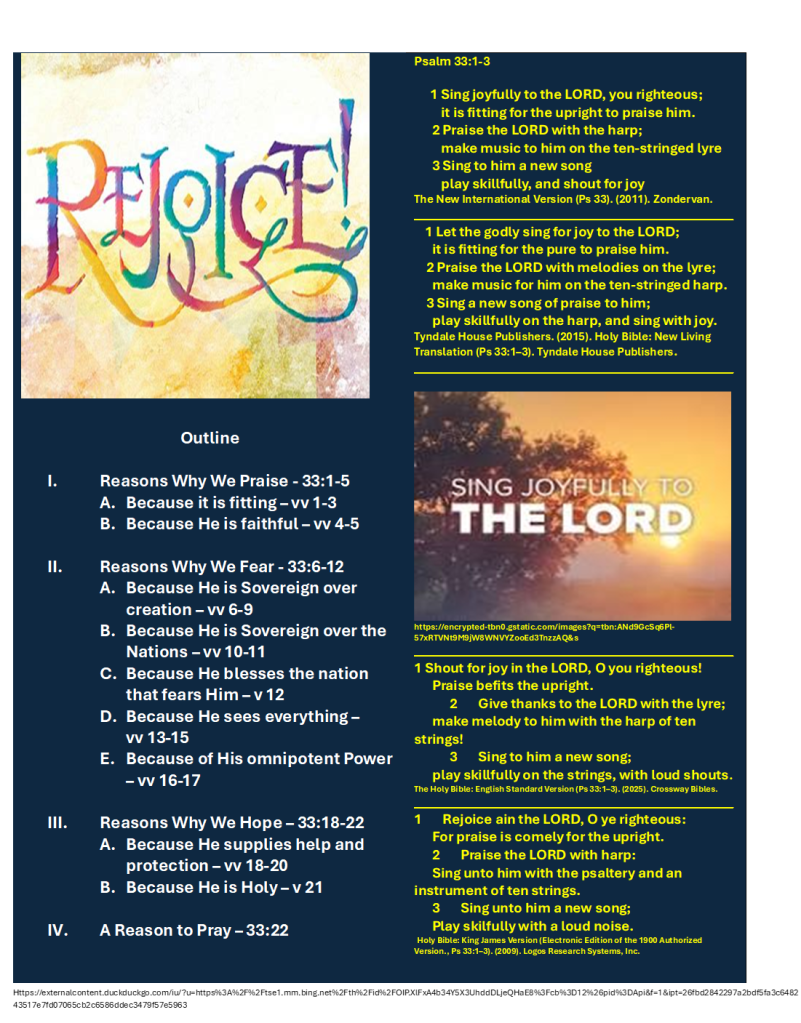
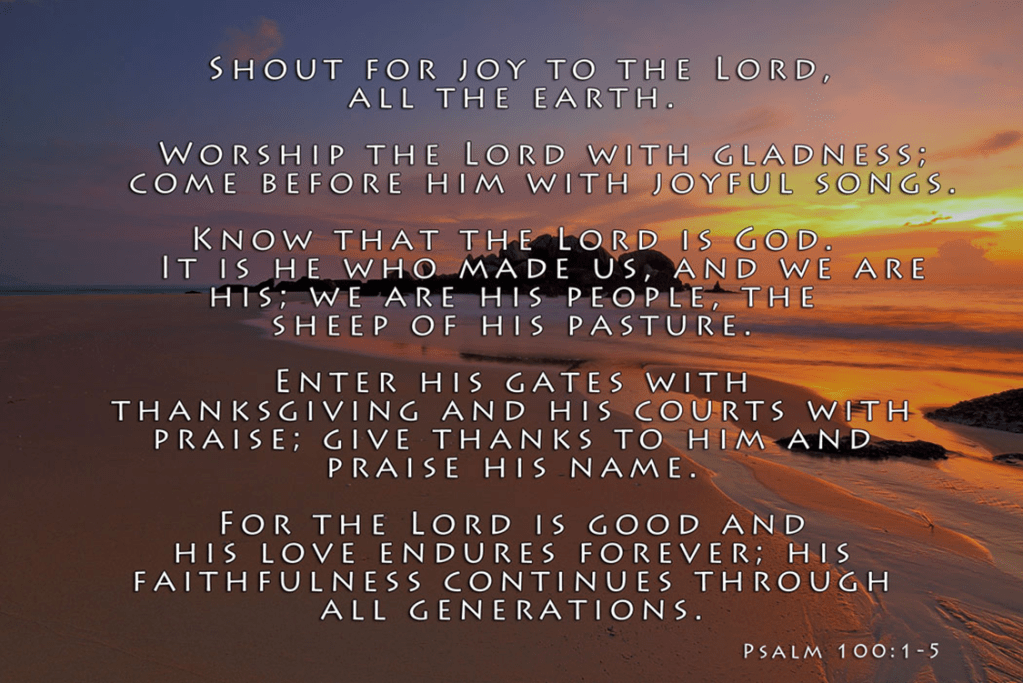
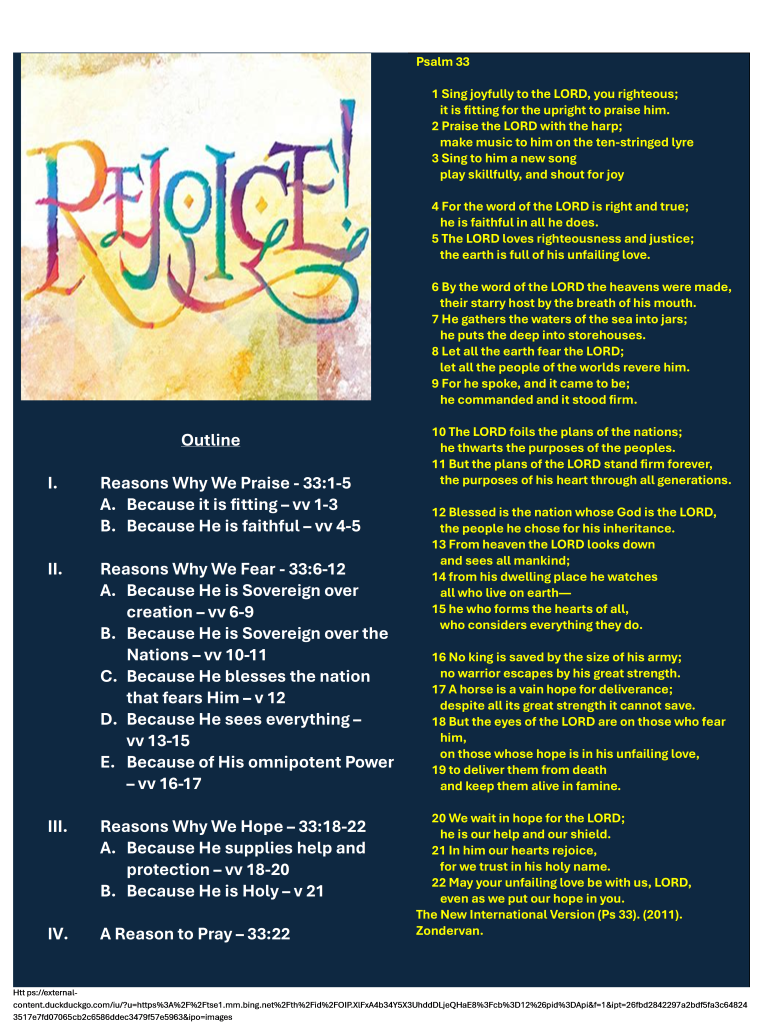



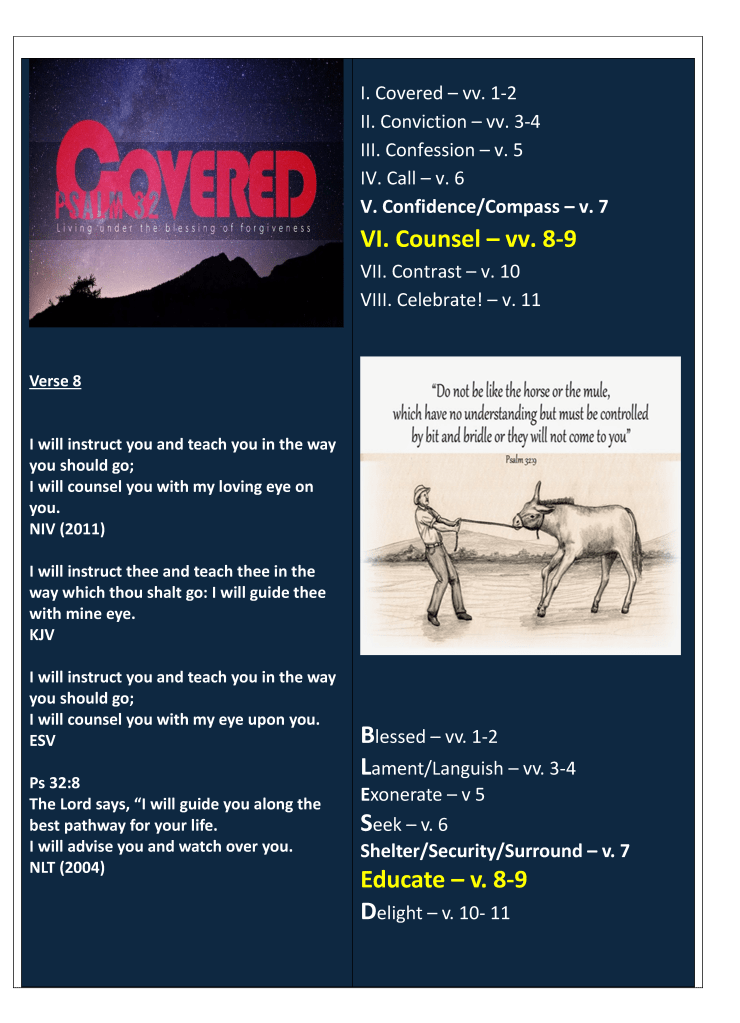


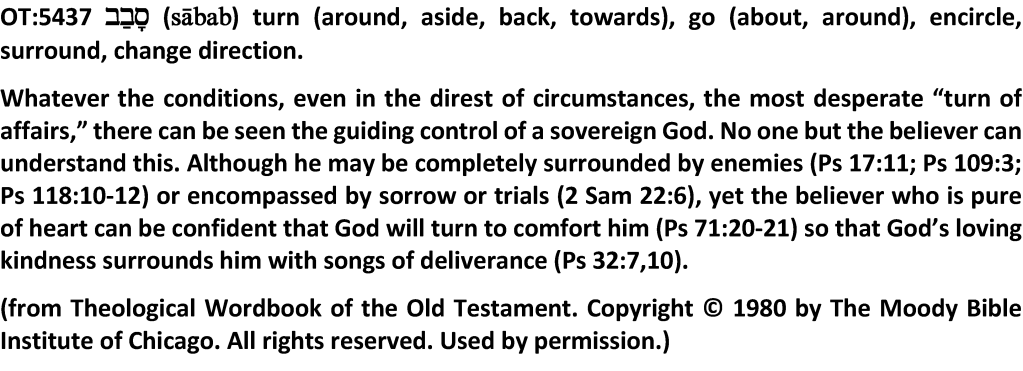
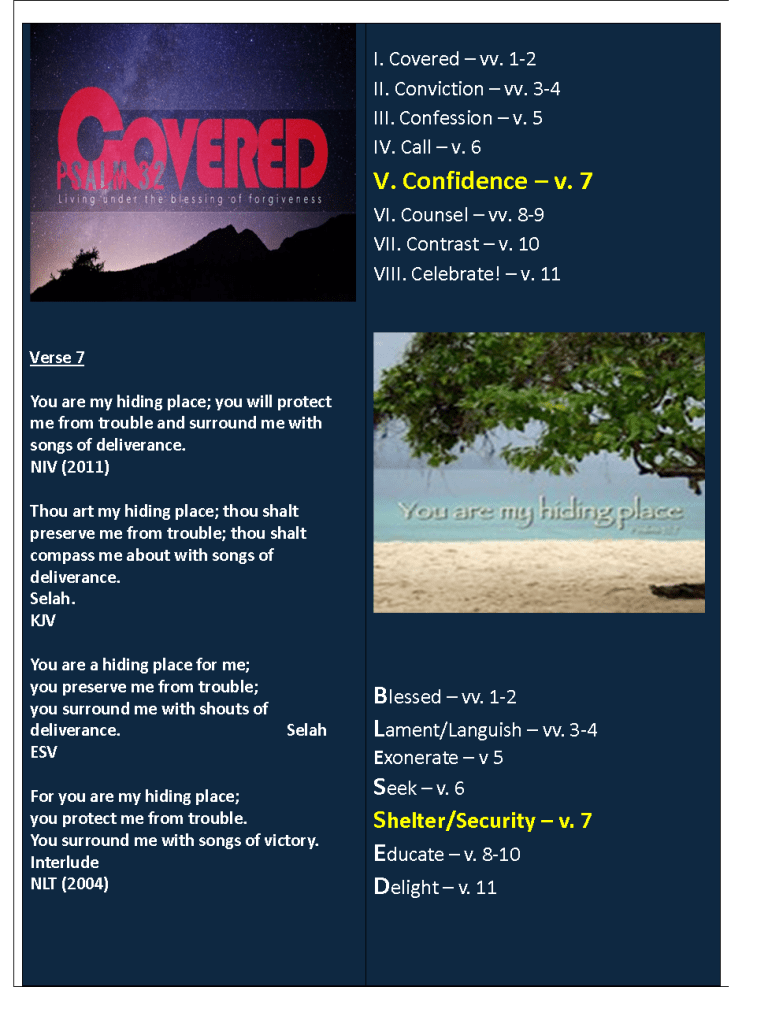

 Psalms For The Journey